Table of Contents
ToggleA living room’s flooring sets the tone for the entire space, it’s the foundation that anchors design choices and determines how comfortable a room truly feels underfoot. In 2026, luxury flooring goes beyond aesthetics: homeowners seek materials that combine durability, timeless appeal, and genuine quality. Whether planning a refresh or building from scratch, understanding the practical differences between flooring options helps avoid costly mistakes. This guide explores seven luxury living room flooring ideas that deliver sophistication without sacrificing real-world durability. Each option comes with honest talk about installation complexity, maintenance reality, and when to call a professional.
Key Takeaways
- Wide-plank hardwood flooring remains a luxury living room flooring standard that improves with age, with white oak currently favored for durability and moisture resistance at $6–18 per square foot installed.
- Natural stone options like marble, travertine, and slate deliver authentic luxury but require professional installation, regular sealing, and careful maintenance depending on porosity and hardness.
- Large-format porcelain tiles (24×48 inches or larger) create a seamless luxury aesthetic while minimizing grout lines and moisture entry points, though they demand precision subfloor preparation to prevent lippage and cracking.
- Engineered hardwood and luxury vinyl plank provide luxury living room aesthetics at lower costs ($4–10 per square foot) with easier installation and maintenance, though they cannot replicate the warmth and patina of solid wood.
- Matte and satin finishes now dominate 2026 luxury designs over high-gloss sheens, offering a more sophisticated appearance while hiding scratches better.
- Professional installation is essential for hardwood, stone, and large-format tile to avoid costly mistakes like cupping, inadequate sealing, and moisture-related failure.
Wide-Plank Hardwood Flooring
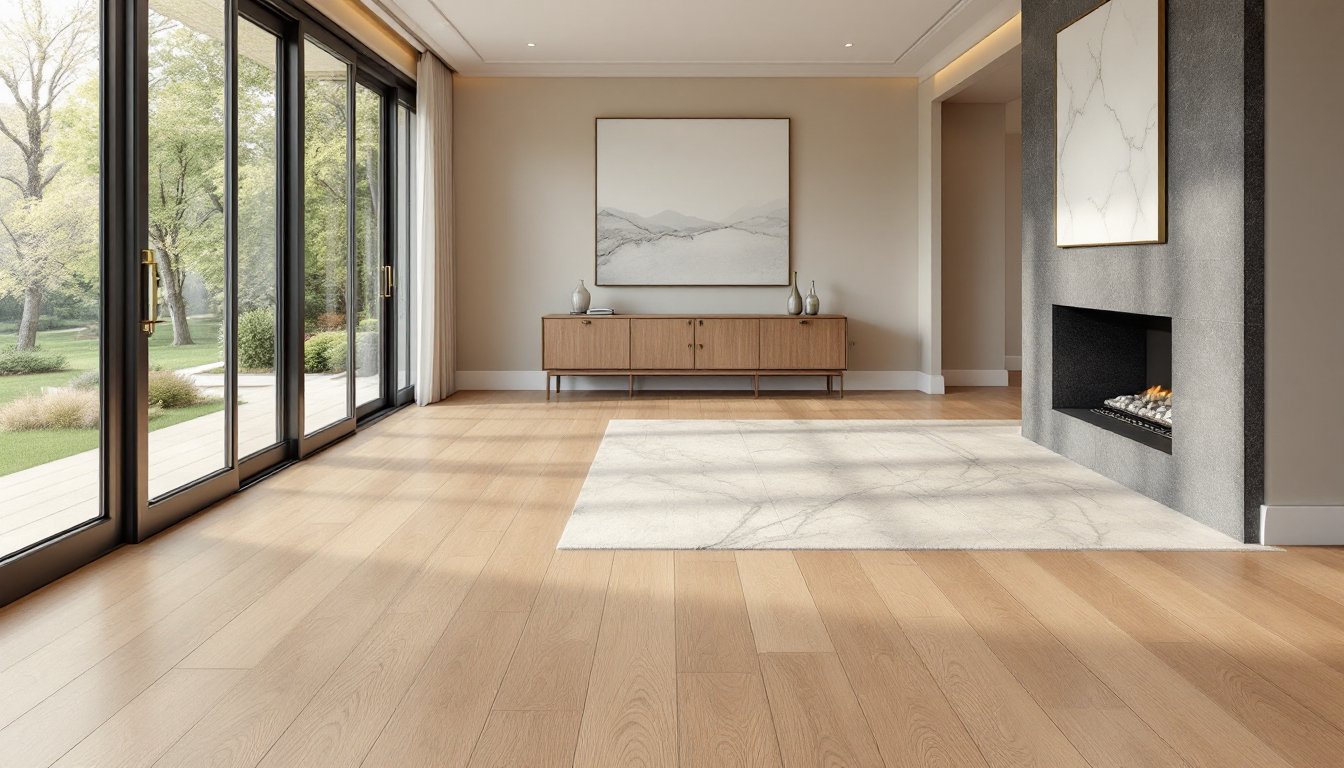
Wide-plank hardwood remains a cornerstone of luxury flooring for a reason: it’s timeless, adds genuine warmth, and improves with age. Planks wider than 5 inches (and often 7–10 inches) visually expand a room and reduce the number of seams, creating an uncluttered, high-end appearance.
Premium Wood Species and Finishes
Walnut, white oak, and maple dominate luxury installations, each bringing distinct character. White oak is the current favorite, it’s extremely durable (Janka hardness of 1360), resists moisture better than red oak, and accepts stains and matte finishes beautifully. Walnut delivers deep chocolate tones and prestige but costs more and requires careful maintenance (it scratches more easily than oak). Maple is extremely hard and takes a glass-like finish well, though its tight grain reads as more contemporary than rustic.
Finish type matters as much as species. Prefinished hardwood arrives with factory-applied finishes (polyurethane, oil-based, or water-based). It skips on-site finishing dust and curing time, a genuine advantage in occupied homes. Site-finished hardwood allows custom color and sheen: a pro sands, stains, and seals it in place. Site finishing costs more upfront but offers unmatched customization.
Matte and satin finishes dominate 2026 luxury designs, moving away from high-gloss plastic-looking sheens. Matte shows footprints and dust more readily but reads as more sophisticated and hides scratches better than glossy. Real wood naturally moves: plan for seasonal expansion and contraction by acclimating wood indoors for 2–3 weeks before installation and maintaining 35–55% humidity year-round.
Expect $6–15 per square foot for premium prefinished hardwood, or $8–18 for site-finished installation. Professional installation is strongly recommended, improper acclimation or fastening leads to cupping, crowning, and gaps.
Natural Stone Elegance
Natural stone conveys undeniable luxury. Each slab is unique, formed over millennia, and carries that authenticity into a room. Stone works especially well in open-plan living areas where its coolness balances wood accents elsewhere.
Marble, Travertine, and Slate Options
Marble is the gold standard of luxury flooring but demands respect. It’s relatively soft (Mohs hardness of 3–4), etches easily under acidic substances (wine, lemon juice, vinegar), and stains if not sealed regularly. Honed (matte) marble hides etch marks better than polished (glossy) finishes, making it more practical for active living rooms. Expect $15–30+ per square foot installed. Veining is random: some prefer dramatic patterns while others seek subtler tones. Carrara marble offers cool whites and grays: Calacatta delivers bolder, darker veining and higher cost.
Travertine is a softer limestone beloved for its warm, earthy palette and natural texture. It’s more forgiving than marble, scratches and minor stains blend into its porous nature. But, travertine requires regular sealing and can trap moisture in bathrooms or kitchens (less ideal in open-plan layouts connected to water zones). It runs $8–15 per square foot installed, making it a more accessible luxury option.
Slate is exceptionally durable (Mohs hardness of 7) and naturally slip-resistant. Its layered appearance suits contemporary and rustic aesthetics equally. Slate ranges from gray and charcoal to rusty reds and purples. It’s less expensive than marble, $10–20 per square foot, and requires less maintenance, though it’s more porous and benefits from regular sealing.
All natural stone demands professional installation. Mortar and grout chemistry matters: using the wrong products causes premature deterioration. Thin-set mortar, proper slope for moisture control, and appropriate grout (usually epoxy for high-traffic areas) are non-negotiable. Stone also needs protection: apply a quality impregnating sealer immediately after installation and reapply annually. Budget an extra $1–2 per square foot for professional sealing and grouting.
Large-Format Porcelain Tiles
Porcelain tiles, especially large-format options like 24×48 inches or larger, blur the line between high-end ceramic and stone. Modern manufacturing creates tiles that convincingly mimic marble, limestone, or wood grain without stone’s maintenance headaches.
Installation Patterns and Design Impact
Large-format tiles minimize grout lines, creating a seamless, contemporary luxury feel. Fewer seams mean fewer water entry points and easier cleaning, a practical win for busy households. The downside: installation is less forgiving. Tiles must be perfectly level: any deflection in the subfloor telegraphs through large tiles, causing lippage (visible height differences at grout joints) and potential cracking under load.
Subfloor preparation is critical. A wood subfloor must be at least 1.25 inches thick, secured with ring-shank nails or screws every 8 inches, and felt underlayment or crack isolation membrane applied before thinset mortar. Concrete subfloors require moisture testing (calcium chloride test should show ≤3 lbs/1000 sq ft/24 hrs per ASTM F1869): moisture vapor issues cause tile adhesive failure and mold.
Layout patterns significantly affect room perception. Running bond (staggered seams, like brickwork) is forgiving and directs the eye horizontally, expanding the perceived width. Large-format tiles in a straight grid emphasize geometry and work beautifully in modern spaces but demand precision. Herringbone or chevron add visual interest but require more cuts and waste: leave this to a pro.
Grout color choice influences the entire aesthetic. White or light grout emphasizes tile size and minimizes seam visibility: colored grout (charcoal, warm gray) grounds the space and adds depth. Epoxy grout resists staining and moisture better than cement-based grout but costs more and requires experienced installation.
Large-format porcelain tiles run $6–15 per square foot: professional installation adds $5–10 per square foot. Mistakes compound at this scale, so hire an experienced installer familiar with large-format tile.
Engineered Wood and Luxury Vinyl Plank
For those seeking the look of hardwood with less fussiness, engineered hardwood and luxury vinyl plank (LVP) offer genuine luxury aesthetics at lower cost and installation complexity.
Engineered hardwood is real wood veneer (typically 2–6mm thick) bonded to a plywood or high-density fiberboard (HDF) core. The cross-grain construction resists cupping and movement far better than solid wood, making it ideal for basements, kitchens, or homes with inconsistent humidity. Modern engineered options look identical to solid hardwood, particularly in wider planks (6–9 inches) with authentic finishes. Engineered wood typically costs $4–10 per square foot (installed), roughly half the price of premium solid hardwood. Installation is faster and simpler: many float over a moisture barrier, reducing prep work and timeline. But, engineered wood can’t be refinished like solid hardwood (the veneer is too thin), so finish quality at purchase is permanent.
Luxury vinyl plank (LVP) has matured dramatically. Today’s products feature photographic wood or stone imaging, authentic embossing, and rigid-core construction that mimics the feel of solid flooring underfoot. LVP is waterproof, making it suitable for basements and humid areas where solid or engineered wood would fail. It resists scratches and stains remarkably well, and cleaning requires only sweeping and damp mopping, no special finishes or sealers needed.
The honest critique: LVP doesn’t have the warmth or patina of real wood. It’s synthetic, and that shows in direct side-by-side comparison. Rigid-core LVP (such as vinyl composite core or SPC) provides better dimensional stability and insulation than traditional vinyl, though it’s noisier underfoot unless underlayment is installed. Premium LVP runs $4–10 per square foot installed.
Both engineered and LVP can be installed over most subfloors with minimal prep. They’re DIY-friendly if planks are nailed or glued: floating installations are even more approachable. Neither requires the subfloor precision, sealing, or humidity management that stone or solid hardwood demands, making them practical for real-world living.