Table of Contents
ToggleA high ceiling living room offers a stunning architectural advantage, but it also presents a design challenge that many homeowners overlook. Hanging a standard chandelier in a room with 12, 14, or even 20-foot ceilings often leaves the fixture looking lonely and disconnected from the space below. A modern chandelier for high ceiling living rooms isn’t just about adding light: it’s about proportioning, visual balance, and creating an intentional focal point that anchors the entire room. The right fixture can transform an empty vertical space into an inviting, cohesive design. This guide walks through selection, sizing, and installation so that homeowners can choose and hang a chandelier that actually works with their architecture.
Key Takeaways
- A modern chandelier for high ceiling living rooms should follow the 1-inch-per-foot rule: a 14-foot ceiling requires a 14-inch-diameter fixture to avoid looking undersized or disconnected.
- Hang the chandelier 7 to 8 feet above the finished floor regardless of ceiling height—not higher—to maintain visual connection and keep the fixture at eye level when seated.
- Choose contemporary styles like minimalist geometric designs or industrial mixed-materials that create visual weight and command attention without overwhelming the tall space.
- Verify your ceiling framing before installation: the mounting bracket must sit directly on a joist, never between them, to safely support the fixture’s 15 to 40 pounds.
- Specify LED bulbs with CRI 90 or higher and a color temperature of 2700K–3000K for warm light, and confirm the fixture is dimmable to avoid harsh brightness in vaulted spaces.
- Longer wire drops (32 to 48 inches) work well in cathedral ceilings and actually improve light distribution across the room rather than reducing efficiency.
Why High Ceilings Demand The Right Chandelier Choice
High ceilings create visual voids that standard fixtures can’t fill. A small chandelier meant for an 8-foot ceiling looks like an afterthought when hung from a 16-foot expanse. Beyond aesthetics, the wrong proportions can make a room feel cold or unfinished.
The key principle is proportional scale. Designers generally recommend that the chandelier’s diameter should be 1 inch for every foot of ceiling height, so a 14-foot ceiling calls for approximately a 14-inch-diameter fixture. This rule prevents undersizing, which leaves the upper space feeling empty.
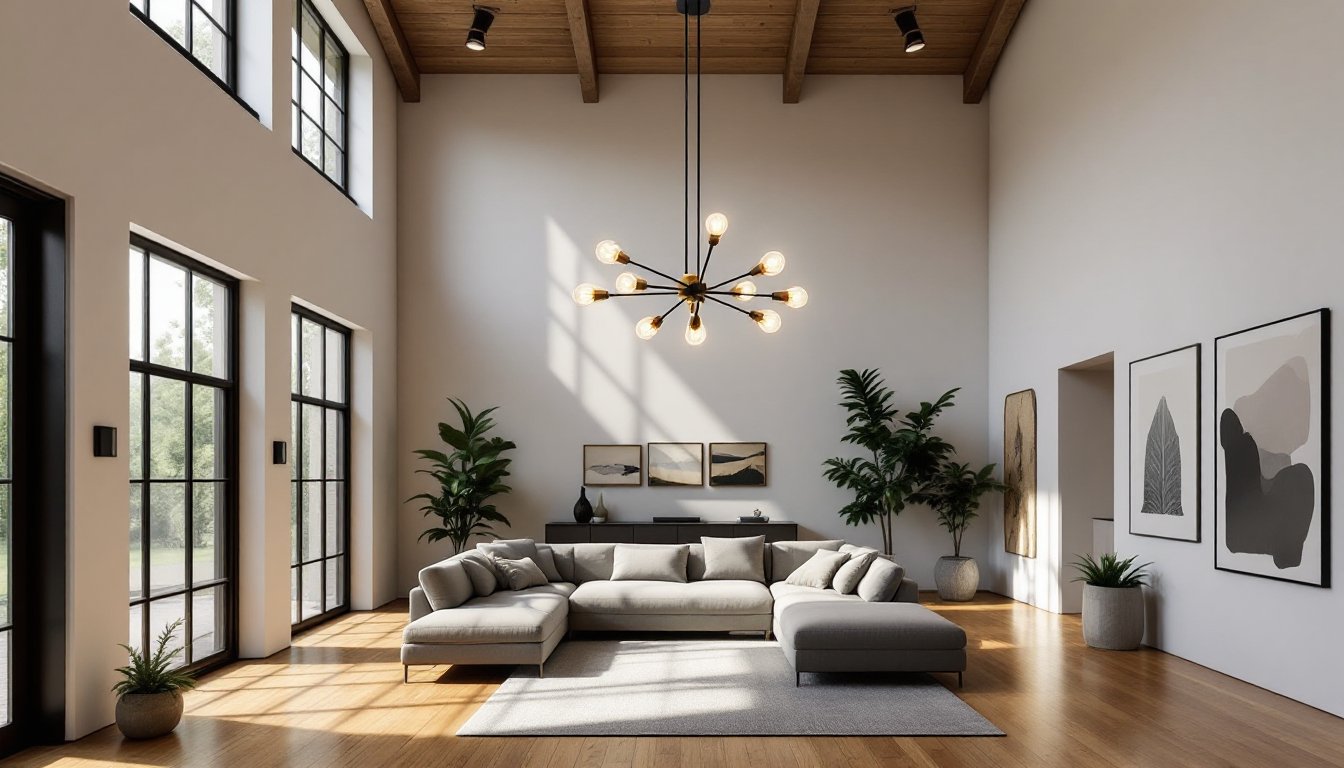
Height placement also matters. The bottom of the chandelier should hang 7 to 8 feet above the finished floor (not 9 or 10 feet), even in vaulted rooms. This keeps the fixture at eye level or slightly above when seated, maintaining visual connection and preventing it from disappearing into the void. Many DIYers mistakenly think “high ceiling = hang it higher,” which actually worsens the disconnection.
Finally, high ceilings amplify visual weight. A thin, delicate fixture can vanish: a modern chandelier with solid geometry, bold lines, or substantial frame elements commands the space without looking heavy or dated. This is why contemporary minimalist and industrial styles often work better than ornate traditional designs in tall rooms.
Contemporary Chandelier Styles That Elevate Modern Living Rooms
Minimalist And Geometric Designs
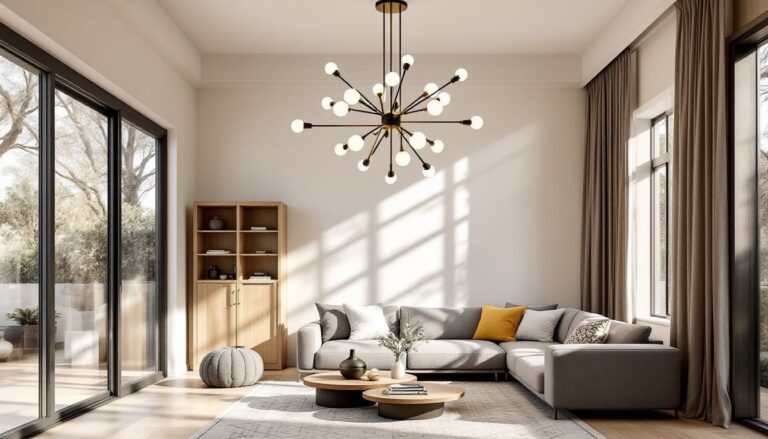
Minimalist chandeliers work exceptionally well in high ceilings because their clean lines emphasize proportion rather than clutter. Fixtures with geometric frameworks, hexagonal, spherical, or linear metal cages, create visual structure without overwhelming the space.
Look for chandeliers with matte black, brushed brass, or chrome finishes and thin-profile arms. These materials reflect light subtly and blend into modern interiors. Linear chandelier designs, which stretch horizontally rather than dropping a single bulb cluster, can anchor a long sectional or dining area without demanding a massive footprint. A 36- to 48-inch linear fixture works well for rooms 12 to 16 feet tall.
Geometric pendant clusters (stacked spheres, staggered rings, or asymmetrical shapes) add visual interest while maintaining modern restraint. These fixtures work because they read clearly from below while creating shadow play and dimension across the ceiling.
Industrial And Mixed-Material Options
Industrial chandeliers combine metal frames (iron, steel) with unexpected materials, Edison bulbs, rope wrapping, concrete accents, or mixed finishes. For high ceilings, the contrast in materials creates visual weight without excess ornamentation.
A fixture combining wrought iron arms with exposed filament bulbs conveys intentionality and craft, making the tall space feel deliberate rather than empty. Mixed materials also let homeowners match existing décor: a brass and glass combo complements warm wood floors: a matte black iron frame suits concrete and steel accents.
Industrial designs scale well because their structural honesty reads at distance. The eye follows the form even from across a large room. Avoid overly spindly or thin-walled options in industrial style, they look cheaper and don’t anchor high spaces effectively. Choose fixtures with solid brass tubing or iron that feels substantial.
Sizing And Installation Tips For Vaulted Spaces
Sizing a chandelier for high ceilings requires two measurements: the room’s longest dimension and the ceiling height. Use the 1-inch-per-foot rule as a baseline. A 14×20-foot room with a 16-foot peak calls for a 14- to 16-inch-diameter fixture, not smaller.
When shopping, check the fixture’s total drop length (mounting bracket to lowest bulb or crystal). A fixture with a 24-inch drop hanging from a 16-foot ceiling will still sit well above sightline. Longer drops (32 to 48 inches) work for cathedral or vaulted ceilings, but they require sturdy ceiling joists rated for the fixture’s weight.
Before installation, homeowners should verify their ceiling framing. Most residential ceilings use wooden joists or trusses: commercial-grade vaulted ceilings may use steel. A chandelier typically weighs 15 to 40 pounds. Check that the mounting box sits directly on a joist, never between them. If the existing electrical box isn’t on a joist, a brace bar must span between two joists to distribute the load safely.
Electrical runs matter too. High ceilings mean longer wire runs from the junction box to the chandelier. Verify the fixture’s wiring reaches: many modern chandeliers come with 4 to 6 feet of flex or chain-covered wire. If runs exceed this, hire a licensed electrician to extend the feed and ensure code compliance.
Installation itself demands a sturdy ladder (not a step stool) and a helper. One person holds the fixture while the other secures mounting hardware and wiring. Trying to balance a chandelier and wrench simultaneously is how accidents happen.
Lighting Performance And Energy Efficiency Considerations
Modern chandeliers for high ceilings often use LED bulbs, which produce sufficient lumens while consuming 80% less energy than incandescent options. A 14-inch fixture with six 10-watt LED bulbs (roughly 600 lumens per bulb) delivers around 3,600 lumens, enough to light a 20×20-foot space as a primary source (though most living rooms benefit from layered lighting).
When evaluating brightness, check the fixture’s lumen output and CRI (Color Rendering Index). Cheap LEDs with low CRI (80 or below) cast a sickly, artificial light. Aim for CRI 90 or higher and a color temperature between 2700K and 3000K for warm, inviting residential light.
Dimmability is critical in high-ceiling spaces. A fixture locked at full brightness can feel harsh and sterile. Confirm the chandelier is compatible with dimmers: not all LED bulbs work with standard dimmers. Look for fixtures labeled “dimmable” and pair them with dimmers rated for LEDs if using non-incandescent bulbs.
Many homeowners worry about fixture-to-ceiling distance reducing efficiency. Vaulted ceilings actually benefit from long drops because light disperses over the room rather than bouncing straight back. A chandelier hanging 8 feet off the floor from a 16-foot ceiling spreads light more evenly than a fixture jammed against a low ceiling would.
Conclusion
Choosing a modern chandelier for high ceiling living rooms comes down to proportion, placement, and intentionality. Size the fixture to the room’s scale, keep the bottom at roughly 7 to 8 feet above the floor, and select contemporary styles, minimalist geometry or industrial mixed-materials, that command attention without clutter. Install securely on a joist-mounted bracket, spec LED bulbs with high CRI, and confirm dimmability for flexibility. The right fixture transforms an architectural asset into a visual anchor, turning empty vertical space into a designed, finished room.