Table of Contents
ToggleLarge windows flood a living room with natural light and views, but they’re notoriously tricky to dress. Too much coverage and the space feels dark and cramped: too little, and sunlight bleaches furnishings while creating glare on screens. The right window treatment balances light control, privacy, insulation, and aesthetics without overwhelming the room. This guide walks through proven solutions for large windows, from classic curtains to cutting-edge motorized shades, helping homeowners make choices grounded in their space’s actual needs rather than Pinterest trends alone.
Key Takeaways
- Assess your living room’s light patterns, window orientation, and climate before selecting large window treatments to balance light control, privacy, and insulation effectively.
- Layering sheers over blackout curtains or motorized shades offers maximum flexibility, allowing you to preserve daytime openness while maintaining nighttime privacy and light blocking.
- Cellular (honeycomb) shades and motorized options provide superior insulation and convenience on large windows, though they cost more than basic roller shades.
- Mount large window treatments high (2–4 inches above the frame) and extend them beyond the window’s width to maximize light control and create a taller, more curated appearance.
- For large windows, stack multiple compact shades side-by-side or use combination systems with separate rods rather than one oversized treatment to avoid sag and ensure smooth operation.
Assess Your Space and Lighting Needs
Before ordering anything, spend a week observing the light patterns in your living room. Note what time of day sun hits hardest, whether glare bothers you during screen time, and how much privacy you actually need. A north-facing window has gentle, consistent light all day: south-facing windows blaze in the afternoon and fade by evening: east windows wake you with morning sun: west windows deliver intense, late-day heat.
Measure the window opening’s width and height in three places (top, middle, bottom) because frames can shift. Don’t assume it’s square. Check whether your walls can support a full-height treatment, some living rooms have radiators, electrical outlets, or architectural details that complicate installation. Confirm your ceiling height and framing: this determines whether you’re mounting on the frame itself or on the wall above and beside it.
Consider your climate too. In cold regions, thermal treatments reduce heating loss. In hot climates, reflective or blackout shades cut cooling costs. In humid areas, avoid wood or paper-based products that swell and warp. Finally, think about your décor’s weight and texture. A minimalist space calls for sleek, flat panels: a traditional room can handle heavier, gathered fabric.
Curtains and Drapes for Maximum Impact
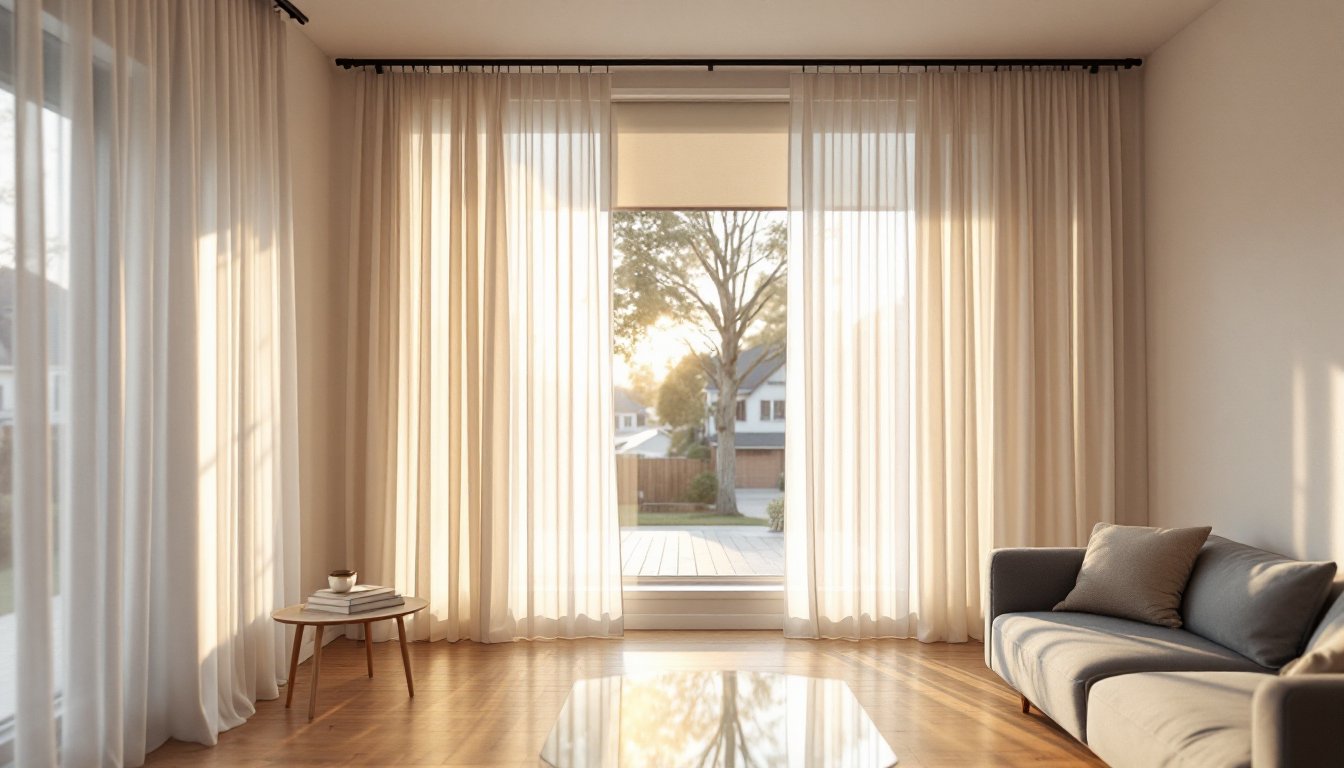
Full-length curtains and drapes command visual space and offer the most textile flexibility. They’re ideal for large windows because their sheer volume and length make the room feel taller and more curated. The key is hanging them high, ideally 2 to 4 inches above the frame, and extending them beyond the window’s width on each side to maximize light control and create clean sight lines.
Sheer and Lightweight Options
Sheer or semi-sheer curtains filter light without blocking views. They soften glare on screens, reduce UV fade slightly, and add a soft, layered look. Linen blends and cotton voiles drape beautifully on large windows without the stiffness of older synthetics. Most sheers measure 54 to 120 inches wide per panel: a large window usually needs two to four panels for fullness. Hang them on a sturdy rod rated for the fabric weight, a standard 5/8-inch rod works for sheers under 6 pounds per panel.
Sheer panels are nearly transparent and won’t insulate or darken a room. Use them when you want light and views, or pair them with a second layer for control.
Blackout and Thermal Solutions
Blackout curtains are woven with a dense, light-blocking backing, typically a latex or acrylic compound that stops 99% of sunlight. Thermal-lined drapes add an insulating layer that reduces heat transfer. These heavier fabrics (10 to 15 pounds per panel for large windows) require a heavy-duty rod, wall brackets rated for at least 20 pounds, and often a second bracket at the center for sag-prone spans over 96 inches.
Blackout fabrics come in polyester, velvet, or cotton blends. Polyester is durable and affordable: velvet feels luxurious but collects dust: cotton is breathable but less dense. For a living room, many homeowners choose a hybrid: sheer panels over blackout ones that can be drawn only when needed. This preserves daytime openness while allowing night-time privacy and light blocking. Installation is straightforward, use a level to mark bracket placements, drill pilot holes, and use appropriate wall anchors if you’re not hitting studs.
Blinds and Shades That Fit Large Frames
Blinds and shades offer compact, mechanical light control. Roller shades are minimal and clean: Roman shades add soft fabric appeal: cellular (honeycomb) shades provide excellent insulation. For very large windows, consider stacking multiple shades side by side rather than one massive unit, easier to manage, fewer mechanical strains, and cleaner visuals.
Measure your window frame and decide whether to mount inside or outside the frame. Inside mounts sit flush with the frame, save wall space, and look integrated: outside mounts cover more area, block side light leaks, and usually work better on large openings. Inside mount widths should be 1/2 inch less than the frame opening’s width to allow operation clearance.
Roller shades roll up into a compact cassette at the top. Most come in blackout, room-darkening, or sheer vinyls. They’re affordable, durable, and work well on oversized windows. Fabric selection matters: dual-roller mechanisms let you operate two independent layers (sheer over opaque) without stacking hardware.
Roman shades fold up in horizontal pleats and come in light-filtering, blackout, and thermal varieties. They look more finished than rollers and work on arched or curved window tops. But, they take up vertical space when fully raised, which matters in rooms with limited wall height above the window.
Cellular shades trap air in honeycomb cells, insulating far better than flat fabrics. Single-cell versions are lightweight: double-cell models are thicker and more efficient. They work excellently on large, thermally demanding windows. The catch: cellular shades are pricier than basic rollers, and the cell structure can collect dust, vacuum gently with a soft brush attachment monthly.
Modern Motorized Options
Motorized blinds and shades operate via remote, wall switch, or smartphone app. They’re convenient for high, hard-to-reach windows and allow precise scheduling (close shades at sunrise to prevent glare, open them at sunset). Most run on rechargeable or battery-powered motors: some wire into home automation systems.
Motorized systems cost 2 to 3 times more than manual versions. Popular options include motorized roller shades, motorized Roman shades, and motorized cellular shades. Brands like Lutron, Somfy, and IKEA Fyrtur offer mid-range solutions. Installation requires drilling for the motor housing and running a power source or using batteries. If hardwiring is necessary, a licensed electrician should handle it, local codes may require a dedicated circuit.
For renters or those reluctant to hardwire, battery-operated motors retrofit many existing shades. They’re simpler to install and removable when moving. The tradeoff: batteries need replacing every 1 to 2 years depending on use. In large windows, consider motorizing only the shades you’ll actually operate frequently: static back panels reduce cost while maintaining visual balance.
Layering Multiple Window Treatments
The most sophisticated approach for large windows is layering, combining sheer and opaque panels, or pairing shades with curtains. This approach gives unmatched flexibility: daytime openness with sheer curtains and closed shades for privacy, nighttime darkness with both layers drawn, and seasonal adjustments by swapping fabric weights.
A classic three-layer system uses lightweight curtain panels flanking the window, a motorized shade in the center for active light control, and optional blackout curtain liners sewn or clipped behind. This spreads visual weight, uses each layer’s strength (curtains for aesthetics and heat reflection, shades for control), and avoids one oversized treatment that can look heavy.
When layering, coordinate mounting heights and depths. The shade should sit forward of the curtain rod so the curtain closes over the shade’s edge. Shades mounted inside the frame and curtains outside the frame never interfere. If both are outside-mounted, space them at least 3 to 4 inches apart front to back.
For large windows, avoid stacking too many components on a single rod, weight adds up, sag becomes a problem, and operation gets clunky. Multiple rods or a combination of rod-mounted and wall-mounted hardware is cleaner. In terms of fabric choices, pair complementary colors and textures: neutral blackout lined curtains with geometric sheer panels, or soft Roman shades in a solid tone with linen drapery in a print.
Layering costs more upfront, but the long-term payoff, precise environmental control, flexible aesthetics, and durability through seasonal use, justifies the investment on high-impact windows.